Right-Curved Penis: When Is Curvature Considered Normal? (Anatomical Guide)
The Right-Curved Penis is a common and usually natural anatomical variant, but assessing its curve is crucial to rule out acquired conditions like Peyronie’s Disease, which requires immediate medical diagnosis. The distinction relies on the presence of pain, speed of onset, and the consistency of the curve over time, which determines the need for intervention.
Important Medical Disclaimer
A new, painful, or worsening curve is a clinical red flag for Peyronie’s Disease and requires evaluation by a urologist. Non-surgical options have no proven efficacy for congenital curvature.
Why Is Assessing the Right-Curved Penis Crucial for Risk Mitigation?
Assessing the Right-Curved Penis is crucial for risk mitigation because acquired lateral curvature (Peyronie’s) requires immediate medical diagnosis to prevent progressive functional loss.
How Prevalent Is the Right-Curved Penis Natural Variation?
The Right-Curved Penis is a common congenital variation that appears in a significant minority of the male population. This dextral curvature is a standard morphological variation, often linked to genital asymmetry where the right testicle is higher than the left. Clinical consensus states that minor lateral curvature is observed in over 10% of males, although sinistral curvature is statistically more frequent. The Right-Curved Penis is a common congenital variation observed in approximately 10% of males.
| Erection Angle Category | Estimated Prevalence | Curvature Plane |
|---|---|---|
| Upward/Downward | ≈ 45% | Dorsal or Ventral. |
How to Distinguish the Right-Curved Penis from Peyronie’s Disease
Distinguishing the Right-Curved Penis from Peyronie’s Disease requires assessing the presence of pain and the suddenness of onset. Peyronie’s Disease (PD) is an acquired condition involving fibrosis in the Tunica Albuginea and typically presents later in life (4th-5th decade).
AUA Guidelines explain that PD often results in sharp pain in its acute phase, and the curve is progressive, unlike the stable congenital curvature. The difference is pathology: Congenital is pain-free and stable since puberty; Peyronie’s is painful and progresses over time.
- Natural Curve: Present since puberty; pain-free; uniform curve.
- Peyronie’s: Sudden onset; often painful/tender; curve severity increases over time.
What Anatomical Factors Define the Right-Curved Penis Mechanics?
Anatomical factors define Right-Curved Penis mechanics through asymmetrical Corpora Cavernosa expansion during erection.
Which Anatomical Imbalances Cause the Right-Curved Penis?
Anatomical imbalances cause the Right-Curved Penis by ensuring the left corpus cavernosa expands more than the right during engorgement. The natural curve is caused by a slight difference in the elasticity of the Tunica Albuginea of the two Corpora Cavernosa chambers, making the right side the inner, less elastic arc (Reference). Asymmetry in the length or elasticity of the two Corpora Cavernosa causes unequal expansion during erection resulting in a consistent lateral bend. This mechanical principle dictates that the shaft bends toward the side of restricted elasticity (the right side).
| Anatomical Structure | Role in Curvature | Contribution to Right-Curved Penis |
|---|---|---|
| Corpora Cavernosa (Right) | Erectile Chamber | Inner Arc: Shorter or less elastic. Acts as the tether or pivot point for the curve. |
| Corpora Cavernosa (Left) | Erectile Chamber | Outer Arc: Longer or more elastic. Expands further, driving the penis to bend right. |
| Tunica Albuginea | Outer protective layer | Tension Regulator: Asymmetric compliance dictates the limit of expansion for each side. |
How to Accurately Measure the Right-Curved Penis Vector
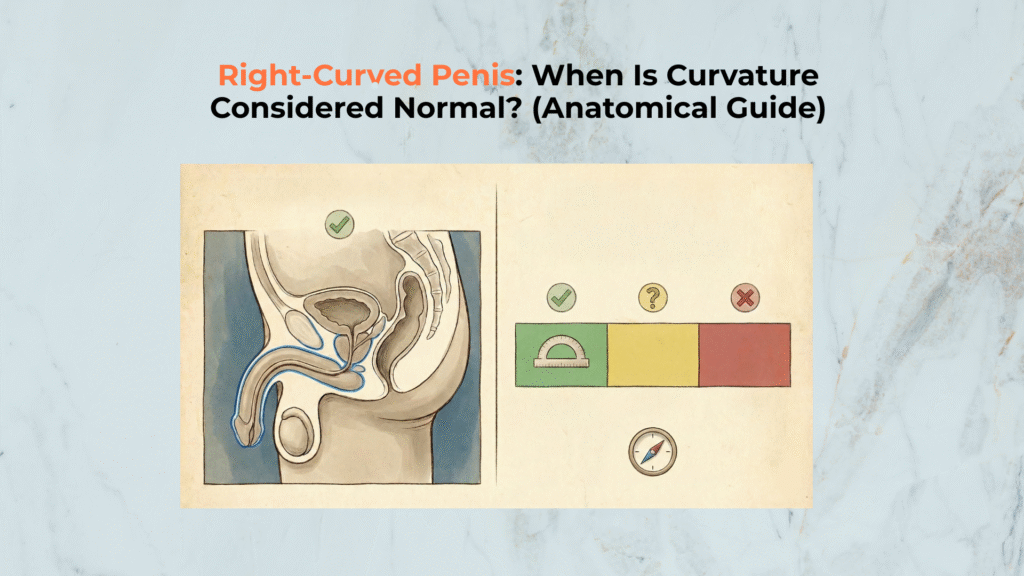
Accurately measuring the Right-Curved Penis vector requires viewing the shaft from a Superior View Projection to determine the angle relative to the midline. Measurement should use the Superior View Projection to quantify Dextral Deviation, as patient self-assessment is notoriously unreliable (NCBI Source). Cite urological standards noting that the angle is measured off the midline; a curve exceeding 30 degrees is the threshold for functional concern and potential intervention. This objective measurement helps assess whether the curve requires medical intervention (surgery) or merely positional adaptation.
- View the erection from the superior aspect (top view).
- Use a protractor app or tool to measure the angle (degrees) off the midline.
- Note the angle to confirm if it is less than the 30-degree threshold for concern.
How Does the Right-Curved Penis Friction Profile Compare to Straight Shapes?
The Right-Curved Penis friction profile compares to straight shapes by concentrating pressure on the Left Lateral Vaginal Wall during linear thrusts. The dextral vector acts as a directional probe, generating Asymmetric Pressure Distribution and Targeted Fissure Stimulation. The lateral vector of the Right-Curved Penis concentrates friction on the Left Lateral Vaginal Wall providing consistent pressure on one side. This allows the curve to act as a specialized stimulating tool.
| Mechanical Feature | Right-Curved Penis | Left-Curved Penis | Straight Erection |
|---|---|---|---|
| Primary Target | Left Lateral Wall | Right Lateral Wall | Central Canal / Cervix |
| Entry Vector | Dextral (Rightward) | Sinistral (Leftward) | Orthogonal |
| Optimal Motion | Figure-8 / Scissoring / Sweep | Figure-8 / Scissoring / Sweep | Piston (Linear) |
Which Sexual Scenarios Best Leverage the Right-Curved Penis Vector?
Sexual scenarios that best leverage the Right-Curved Penis vector are those that utilize rotation and lateral positioning to maximize contact with the curve’s arc.
Why Does the Right-Curved Penis Excel in Lateral and Tilted Positions?
The Right-Curved Penis excels in lateral and tilted positions because angling the body compensates for the curve, maximizing Pelvic Accommodation. When the partner tilts their pelvis to the left, the vaginal canal’s axis shifts, aligning perfectly with the rightward arc of the penis (Source). Tilting the partner’s pelvis can maximize the curve of the Right-Curved Penis for targeted stimulation of the Left G-Spot/A-Spot area. The Spooning position is highly compatible as the lateral entry angle often neutralizes the curve’s tendency to slip out.
- Partner Tilted Left: Tilts the canal to meet the curve.
- Spooning: Aligns the Lateral Wall with the curve’s exit path.
How Does the Right-Curved Penis Dictate Insertion Depth Strategy?
The Right-Curved Penis dictates insertion depth strategy by prioritizing mid-shaft engagement and controlling the angle of entry. The curve’s maximum pressure is exerted at the apex of its arc (the mid-shaft), making Mid-Shaft Engagement the primary mechanic of pleasure. Sexological advice suggests that a strategy of shallower, grinding thrusts often yields better results than deep pounding for curved anatomies. This shift from “depth” to “contact area” is a crucial mental reframe for men with curvature.
| Position Strategy | Effectiveness | Mechanical Rationale |
|---|---|---|
| Reverse Cowgirl (Right Tilt) | Optimal | Partner can lean left, actively aligning the canal to the curve. |
| Missionary (Legs Together) | Medium/High | Compresses the canal, maximizing friction on the curve’s arc. |
| Doggy Style (Shallow) | Medium | Reduces depth, focusing the curve’s arc on the mid-canal. |
How Do Advanced Techniques Optimize the Right-Curved Penis Vector?
Advanced techniques optimize the Right-Curved Penis vector by converting the lateral curve into a targeted stimulating tool through rotational motion.
How to Execute the “Figure-8” Motion with a Right-Curved Penis
Executing the “Figure-8” Motion with a Right-Curved Penis ensures the curve contacts both lateral walls sequentially, maximizing pleasure. This technique leverages the curve’s arc to sweep across the vaginal canal, a technique referenced in sexology guides on rotational motions. Initiating a Figure-8 hip rotation ensures the Right-Curved Penis contacts both the left and right lateral walls sequentially. This motion breaks the monotony of single-spot friction and prevents the soreness that comes from the curve hitting the exact same spot repeatedly.
- Enter fully in a supine position.
- Use circular hip motions rather than purely linear thrusts.
- Vary the speed to maximize the sweep of the curve’s arc.
How to Prevent Discomfort Caused by the Right-Curved Penis
Preventing discomfort caused by the Right-Curved Penis is achieved through Intromission Control and proper lubrication to manage high-pressure points. Intromission Control is the primary mitigation strategy, focusing on slow entry to avoid acute impact pain on the Lateral Vaginal Wall. Ensuring slow intromission prevents the leading edge of the Right-Curved Penis from causing acute impact pain on the Right Lateral Wall. High-quality lubrication is essential to reduce the drag coefficient and prevent mucosal abrasion on the inner curve (the right side).
- [ ] Partner Lead: Partner guides entry to avoid hitting the side.
- [ ] Rotation: Rotate hips slightly left upon entry.
- [ ] Lubrication: Essential for the inner curve’s arc.
How Can the Right-Curved Penis Checklist Ensure Mechanical Advantage?
The Right-Curved Penis checklist ensures mechanical advantage by systematizing the positional and movement adjustments required for optimal sensation.
What Are the Key Mechanical Advantages of the Right-Curved Penis?
The key mechanical advantages of the Right-Curved Penis include superior lateral targeting and compatibility with rotational motions. The morphology offers Asymmetric Friction and reduced cervical collision risk. Clinical consensus affirms the curve’s utility for Targeted Lateral Stimulation and Figure-8 Compatibility. Understanding these advantages reframes the morphology as an asset.
- Targeted Lateral Stimulation
- Figure-8 Compatibility
- Asymmetric Friction
How to Complete the Optimization Checklist for the Right-Curved Penis
Completing this optimization checklist ensures owners of a Right-Curved Penis maximize pleasure and minimize risk. The checklist serves as the final T-Layer Execution tool, consolidating all diagnostic and functional knowledge. Cite the AUA guideline requiring a Diagnostic Check to rule out PD if the curve exceeds the 30-degree functional threshold. Mastery of these techniques turns the anatomical variation into a sexual advantage.
Optimization Checklist
- Diagnostic Check: Rule out Peyronie’s Disease if curvature is new or painful.
- Motion Shift: Prioritize Figure-8 and rotational thrusts over linear motion.
- Targeting: Aim for the Left Lateral Wall for optimal friction.
- Communication: Always ask the partner about side-wall pressure.
Conclusion
In conclusion, the Right-Curved Penis is a common anatomical variation that requires a clinical check to rule out Peyronie’s Disease, but whose dextral vector can be converted into a potent mechanical advantage for targeted Lateral Wall stimulation. The morphology is manageable and can be optimized using biomechanical techniques (Figure-8). Functional success is achieved by understanding Asymmetrical Corpora Cavernosa and using Positional Strategies to maximize the curve’s arc. At FactBasedUrology, we affirm that every unique geometry holds a unique biomechanical advantage. Optimize your curve, and you optimize your pleasure.