
Is an Upward-Curved Penis Considered Attractive or Functional? (Anatomical Guide)
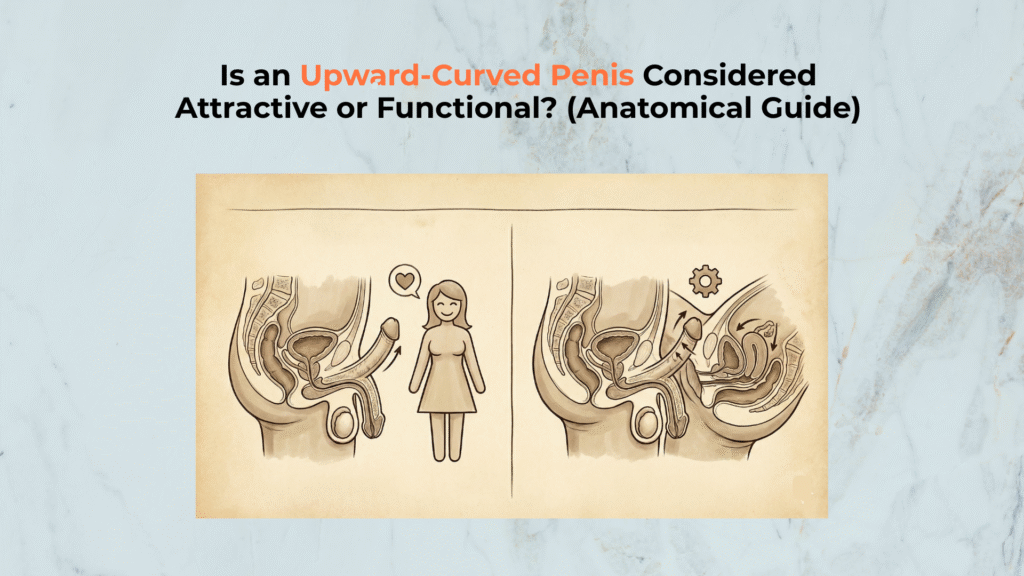
The Upward-Curved Penis is the majority anatomical variant characterized by a shaft that points vertically when erect, caused by high tension in the Suspensory Ligament, which offers a superior mechanical advantage for targeting the Anterior Vaginal Wall.
It is common to feel worried or embarrassed about this morphological variation. However, this angle offers a distinct mechanical advantage for targeting the anterior wall (G-Spot complex) of the partner, optimizing face-to-face positions, although preference remains subjective.
Important Medical Disclaimer
While a stable Upward-Curved Penis is normal, a sudden, painful, or rapidly increasing curve requires evaluation by a urologist to rule out Peyronie’s Disease. Aggressive rear-entry thrusting is a high-risk activity for this morphology.
Upward Curve: At a Glance
- ✔ Is it usually normal or serious? Normal. Over 65% of men have an upward angle.
- ⚠ When should I see a doctor? If the curve is new, worsening, or painful during erection.
- ℹ Can this usually be managed or adapted? Yes, through Coital Alignment Technique (CAT) and positional modifications.
Why Is the Upward-Curved Penis Biomechanically Advantageous for Stimulation?
The Upward-Curved Penis is biomechanically advantageous because its vertical trajectory naturally aligns with the curve of the vaginal canal, facilitating targeted anterior wall stimulation.
How to Interpret the Prevalence Data for the Upward-Curved Penis
The Upward-Curved Penis is the majority phenotype found in a large segment of the male population. This high angulation (0–85 degrees from vertical) is caused by a naturally short or highly tensioned Suspensory Ligament Proper anchoring the shaft to the Pubic Symphysis.
Research by Wessells and Sparling confirms that over 65% of men exhibit an upward erection angle, establishing it as the statistical norm for erect morphology. This frequency establishes the angle as the functional standard for face-to-face copulation.
| Angle Range (Degrees from Vertical) | Estimated Prevalence | Biomechanical Implication |
|---|---|---|
| 0° – 85° (Upward) | ≈65% | Majority Phenotype. Optimized for Anterior Wall contact. |
| 85° – 95° (Horizontal) | ≈10% | Ligament Equilibrium. Neutral angle. |
| 95° – 180° (Downward) | ≈25% | Ligament Laxity. Optimized for Posterior Fornix. |
How Does the Upward-Curved Penis Enhance Anterior Wall Targeting?
The Upward-Curved Penis enhances anterior wall stimulation because its vertical trajectory acts as a specialized probe against the upper surface of the vaginal canal. The curve naturally positions the shaft to “ride the roof” of the vagina, leveraging the Fulcrum Effect (a leveraging motion where the pubic bone acts as a pivot) to target the G-Spot and CUV complex.
Biomechanical Vector: The vertical trajectory of the Upward-Curved Penis → naturally aligns with the Anterior Vaginal Wall → to facilitate G-Spot contact without manual adjustment. This continuous contact simplifies G-Spot stimulation in supine positions.
- Vector Alignment: Natural congruency with the anterior curve.
- Crural Compression: Enhanced pressure against internal structures.
- Pubic Fulcrum: Optimized for leveraging against the symphysis.
Which Anatomical Factors Create the Upward-Curved Penis Curve?
Anatomical factors creating the Upward-Curved Penis curve are primarily the tension of the suspensory ligament and the intrinsic corporeal disproportion.
Which Structures Generate the Tension for an Upward-Curved Penis?
Specific structures generate the tension for an Upward-Curved Penis, primarily the Suspensory Ligament Proper that tethers the shaft to the pelvis. The tension is created when the Suspensory Ligament Proper is short or less elastic, restricting the shaft’s separation from the Pubic Symphysis.
| Anatomical Structure | Role in Curvature | Contribution to Upward-Curved Penis |
|---|---|---|
| Suspensory Ligament | Anchors shaft to pelvis. | Tightness: Pulls the shaft upward, restricting separation. |
| Corpora Cavernosa (Ventral) | Erectile Chamber (Bottom) | Longer/More Elastic: Forms the outer arc of the curve. |
| Corpora Cavernosa (Dorsal) | Erectile Chamber (Top) | Shorter/Less Elastic: Forms the inner arc of the curve. |
How to Accurately Measure the Upward-Curved Penis Vector
Accurately measuring the Upward-Curved Penis vector requires viewing the shaft from a Dorsal Deviation perspective relative to the pubic horizon. The angle is measured relative to the abdominal wall axis, defined by the International Society for Sexual Medicine (ISSM) standards.
- Stand upright to establish the Vertical Axis.
- Visualize a horizontal line extending from the Pubic Symphysis (90°).
- Measure the degree of Dorsal Deviation above this plane.
How Does the Upward-Curved Penis Friction Profile Compare to Straight Shapes?
The Upward-Curved Penis friction profile compares to straight shapes by focusing pressure on the anterior wall rather than distributing it evenly along the central canal. The upward angle creates Asymmetric Pressure Distribution, leveraging the dorsal convexity against the Anterior Vaginal Wall.
Which Sexual Scenarios Best Leverage the Upward-Curved Penis Vector?
Sexual scenarios that best leverage the Upward-Curved Penis vector are those that optimize supine alignment and anterior wall contact.
How to Position the Upward-Curved Penis for Maximum Supine Advantage
Positioning the Upward-Curved Penis for maximum supine advantage (Missionary variations) achieves maximum friction on the Anterior Fornix. The Coital Alignment Technique (CAT) is the biomechanically optimal method, leveraging the upward angle for pubic-on-pubic contact.
- Missionary: Perfect vertical alignment for front wall contact.
- Coital Alignment Technique (CAT): Maximizes pubic-bone contact.
| Position Strategy | Effectiveness | Mechanical Rationale |
|---|---|---|
| Missionary (CAT) | Optimal | Maximizes contact with the G-Spot complex. |
| Spooning (Lateral) | High | Curve creates side-wall pressure, avoiding direct thrusting. |
| Doggy Style (Standard) | Low/Risky | Angle opposes the natural insertion vector; increased risk of buckling. |
How Do Advanced Techniques Optimize the Upward-Curved Penis Vector?
How to Execute “The Rocking Motion” with an Upward-Curved Penis
“The Rocking Motion” leverages the Upward-Curved Penis by utilizing the pubic bone as a pivot point rather than relying on in-and-out thrusting. This motion utilizes the Fulcrum Effect to amplify internal pressure, transforming axial force into vertical pressure.
- Achieve full Intromission in Missionary.
- Cease axial thrusting (in-and-out).
- Initiate Vertical Rocking to use the Pubic Symphysis as a fulcrum against the G-Spot.
How to Prevent Buckling in the Upward-Curved Penis
Preventing Buckling in the Upward-Curved Penis requires modifying rear-entry positions to align the pelvic inlet with the vertical shaft. The primary risk is the “Slip-and-Snap fracture” in non-congruent positions.
Stop immediately and seek urgent medical care if there is sudden sharp pain, a popping sound, rapid loss of erection, or visible deformity (signs of penile fracture).
How Can the Upward-Curved Penis Checklist Ensure Mechanical Advantage?
What Are the Mechanical Advantages?
- Anterior Wall Targeting: Direct stimulation of the G-Spot.
- Clitoral Leverage: Applying pressure against the internal crura.
- High-Friction Contact: Maximized surface area engagement.
How to Complete the Optimization Checklist
Upward-Curved Penis Optimization Checklist
- Position Selection: Prioritize Supine positions (Missionary/Lotus).
- Motion Shift: Switch from “Piston” motions to “Fulcrum” motions.
- Safety Check: Exercise caution with Rear-Entry to prevent penile fracture.
- Lubrication: Essential for the Dorsal Shaft surface area.
Frequently Asked Questions
Is an upward-curved erection normal?
Yes. Clinical data indicates that approximately 65% of men have an erection angle between 0° and 85° (pointing upward), making it the statistical norm and majority phenotype.
Does an upward curve cause pain during sex?
Generally, no. The upward angle is naturally congruent with the vaginal curve. However, deep linear thrusting (piston motion) may hit the cervix. Switching to the CAT technique (grinding/rocking) usually resolves this. If pain persists, consult a urologist.
Can I straighten an upward curve?
Attempting to straighten a natural curve is dangerous and unnecessary. The angle is determined by the strong Suspensory Ligament. Unless the curve is caused by Peyronie’s Disease (scar tissue), it is a functional anatomical asset, not a defect to be fixed.
What is the best position for an upward curve?
Missionary (especially CAT variants) and Spooning are ideal. These positions align the upward vector with the anterior vaginal wall (G-Spot). Rear-entry positions should be approached with caution to prevent buckling.
Conclusion
In conclusion, the Upward-Curved Penis is the statistical norm, a highly functional variation anchored by the Suspensory Ligament that delivers a specific mechanical advantage for Anterior Wall stimulation. The angle is a structural asset and a functional specialist.
Talking to Your Partner: Key Sentences
“Because my angle is naturally optimized for the front wall, let’s try the CAT technique.”
“If you feel sharp pain in this position, we need to stop immediately and adjust the angle, as that can lead to injury.”
At FactBasedUrology, we affirm that every anatomy is a specialist instrument with its own unique biomechanical advantage. Your upward curve is anatomically sound and optimized for maximum anterior pleasure.

3 Responses