How has the Ideal Penis Size Changed Over Time?
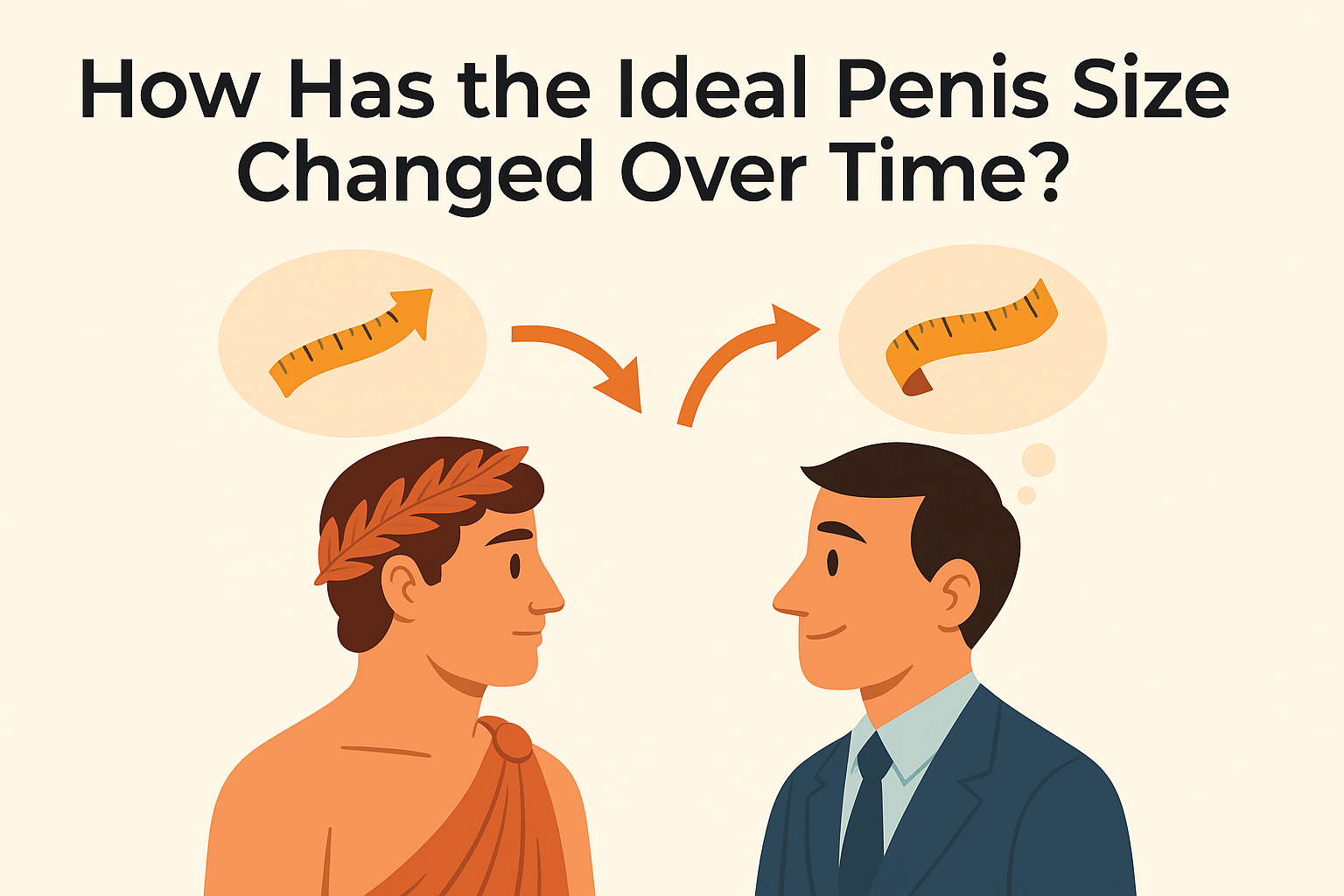
The ideal penis size has changed dramatically over time, with ancient civilizations valuing a smaller, proportioned penis as a mark of intellect and restraint, a standard that has been completely reversed by the modern, media-driven “bigger is better” ideal.
Today’s cultural obsession with a large penis is a relatively recent phenomenon; for much of human history, the opposite was considered desirable.
The perception of the ideal penis size is a fascinating lens through which to view shifting cultural values, especially when considering historical paintings that depict various ideals of penis in proportion.
This guide explores how the ideal penis size changed over time, particularly in relation to the average erect penis length.
We will trace the shifting cultural values from ancient civilizations, through the Renaissance, and into the modern media age, highlighting the school of medicine’s influence on perceptions of size and shape.
By examining art, philosophy, and media, we can deconstruct the modern standard and gain a factual, historical perspective. Understanding the history of the ideal penis size helps to place contemporary anxieties in their proper context, especially for those who are concerned about the size during puberty.
To understand today’s ideals, it helps to explore what ancient cultures believed about penis size throughout history.
What Was the Ideal Penis Size in Ancient Civilizations?
In ancient civilizations like Greece, the ideal penis size was small, slender, and uncircumcised, as this was considered a symbol of rationality and intellectual self-control, while larger sizes were associated with barbarism and uncontrolled lust.
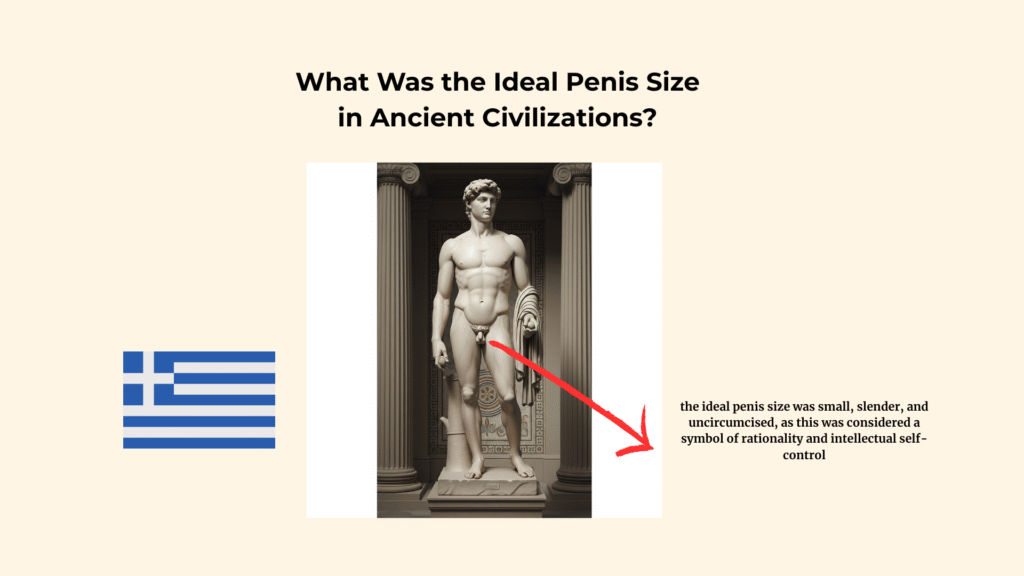
This classical ideal set the standard in Western culture for nearly two millennia and is the complete opposite of today’s prevailing views on penis in proportion to the body.
The following sections break down the specific ideals of ancient Greece and Rome, particularly in relation to penile size, including discussions on the average erect size and the dissatisfaction with penis size in modern men.
The Ancient Greek Ideal: Small and Uncircumcised
The Ancient Greek ideal, as reflected in their sculpture of gods, heroes, and athletes, was a small, slender, and uncircumcised penis, which was culturally associated with the highest virtues of civilization, intellect, and rational self-control.
This aesthetic is clearly visible in surviving classical statues, where the most revered figures are depicted with modest genitalia, reflecting the cultural views on penile size and the concern about the size.
For the Greeks, a small penis was a mark of a man who was ruled by his intellect rather than his base desires, contrasting sharply with contemporary views on erection size, which often assess the ideal penis size based on modern standards.
This established the foundational historical standard for “ideal penis size” in Western civilization, where restraint was considered the ultimate masculine virtue, contrasting with modern ideals that have increased over the past decades.
The Association of Large Penises with Barbarism
In stark contrast to their ideal, the Ancient Greeks associated large, erect penises with lust, foolishness, and the uncontrolled, bestial nature of non-Greek “barbarians” and mythological creatures like satyrs.
Satyrs—the half-man, half-goat companions of the wine god Dionysus—were almost always depicted in art with comically oversized, permanently erect phalluses, challenging the notion of the average size in a humorous way.
This was not a sign of admiration but of mockery. A large penis was used to signify that an individual was ruled by his carnal instincts rather than his reason, placing him outside the bounds of civilized Greek society.
This was the direct antithesis of the “ideal penis length” of the era, which has often been influenced by professional medical advice.
The Roman Shift: A Move Towards Moderation
The Romans, while inheriting many Greek ideals, adopted a slightly more pragmatic view of the ideal penis size, valuing a penis that was well-proportioned and functional for both procreation and pleasure, though still not excessively large.
The Roman perspective was less purely philosophical and more grounded in function, particularly regarding the sexual health associated with penis size.
Art and literature from the Roman period suggest an ideal of moderation a penis that was proportionate to the man’s body, which has been a topic of discussion throughout the centuries.
While this was a slight shift from the Greek focus on smallness as a virtue, the Roman “ideal penis size” was still a far cry from the modern “bigger is better” standard and continued to shun the excessively large as grotesque or comical.
How Did the Ideal Penis Size Change During the Renaissance and Middle Ages?
During the Renaissance and Middle Ages, the ideal penis size largely continued the classical tradition, with Renaissance art reviving the smaller, proportioned Greek aesthetic, further reinforced by Christian morality that associated lust with sin.
Nudity was less common in the art of the Middle Ages, but when the classical form was revived during the Renaissance, so too was the classical ideal of male anatomy, which often emphasized the average size of the male genital.
The Renaissance Continuation of Classical Ideals
Renaissance artists like Michelangelo and Donatello deliberately revived the classical Greek aesthetic, and therefore sculptures like the famous “David” feature a smaller, proportioned penis to reflect the revived ideal of intellectual purity and restraint.
Michelangelo’s works often reflect the ideals of the time, including the representation of penile dimensions that align with the cultural representation of a normal size, which has evolved over the past seven centuries.
David is a perfect example; as a depiction of an idealized heroic figure, his anatomy was consciously sculpted to align with the classical virtues the artists sought to emulate, often reflecting the average size of the period.
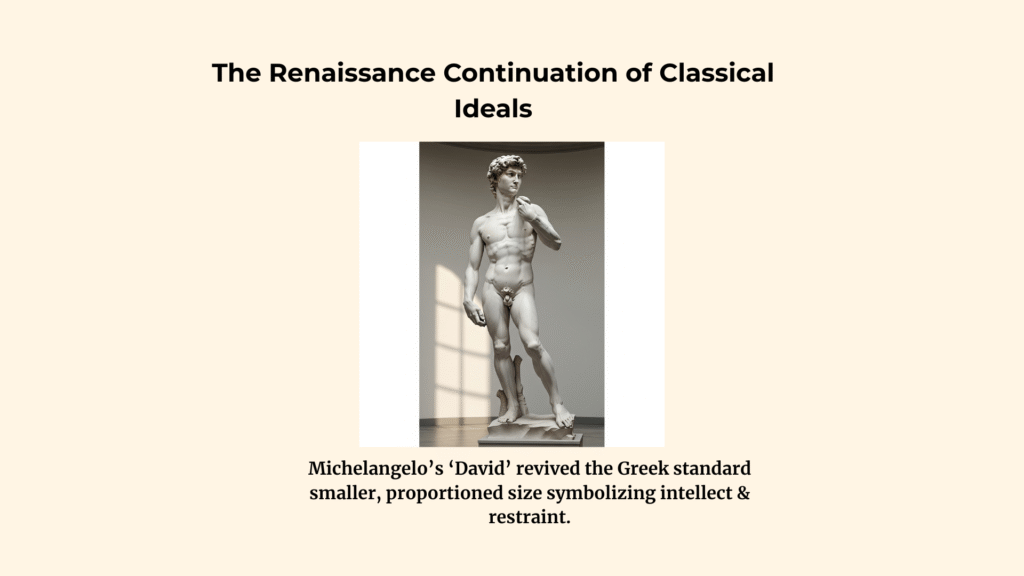
This artistic choice reinforced the long-standing cultural association between modest genitalia and the ideal man, often depicted in paintings in which the penis is minimized.
For Renaissance thinkers, this continuation of the classical standard for the ideal penis size was a way to connect their own era to the perceived golden age of philosophy and art, where the average erect size was not emphasized.
The Influence of Christian Morality
The influence of prevailing Christian morality during this era, which strongly associated lust and carnal desire with sin, further suppressed any notion of a large penis being desirable and reinforced the classical ideal of restraint.
In a theological context where lust was one of the seven deadly sins, any physical attribute associated with an unrestrained sexual appetite, such as an increased size of the flaccid penis, was viewed negatively.
A large penis was symbolically linked to lustful, sinful behavior, often leading to feelings of inadequacy and dissatisfaction with penis size, especially among adult men. Therefore, a smaller, less obtrusive size was more aligned with the virtues of piety, humility, and spiritual control.
This powerful moral framework acted as a major cultural force, helping to maintain the classical “ideal penis size” for centuries.
How Did the Modern Ideal Penis Size Change Over Time?
The modern “ideal penis size” changed over time through a gradual shift that began with the scientific and classification-obsessed mindset of the Victorian era, accelerated during the 20th-century sexual revolution, and was ultimately cemented by the rise of modern pornography.
This reversal of a nearly 2,000-year-old standard happened relatively quickly, fundamentally reshaping cultural attitudes in less than a century, particularly during puberty.
The Victorian Era and the Rise of “Scientific” Measurement
The Victorian era’s obsession with scientific classification and measurement began to shift the cultural focus toward the physical dimensions of the human body, including the penis, although public discussion of the topic remained highly taboo.
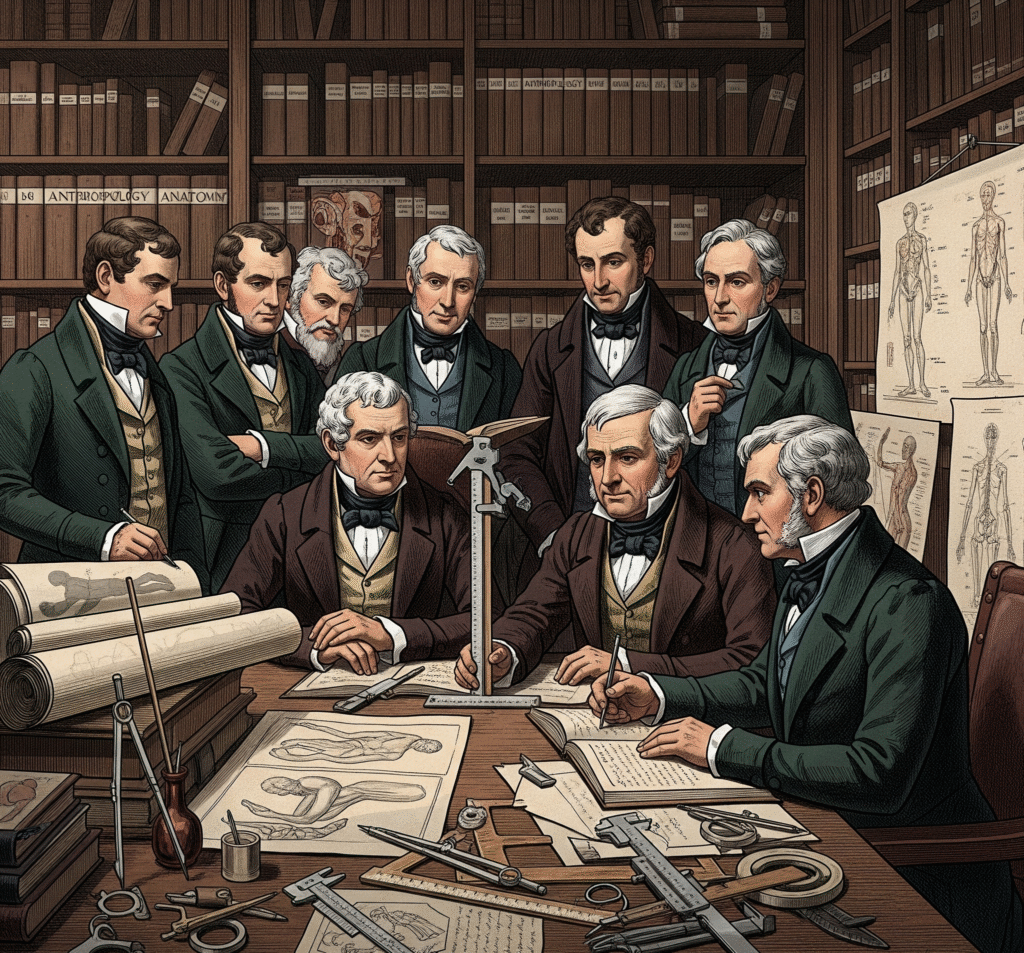
As fields like anthropology and biology sought to categorize and measure everything, the human body became an object of clinical study, often focusing on penis length and its implications for body size.
This created a new mindset that moved away from philosophical or artistic ideals and toward physical data and dimensions, including measurements of penile length in urology, which are often used to determine the size.
While this was a subtle, academic shift, this 19th-century focus on measurement and categorization laid the intellectual groundwork for a more size-focused perspective on the “ideal penis length.”
The 20th Century: The Kinsey Reports and Sexual Revolution
In the 20th century, sex research like the Kinsey Reports brought the topic of penis size into a more open, scientific light, while the subsequent sexual revolution began to culturally dismantle older ideals of restraint and modesty.
The Kinsey Reports of the 1940s and 50s normalized the clinical study and public discussion of human sexuality, including the size of the penis, on an unprecedented scale, paving the way for discussions on penile length to nose length.
Following this, the sexual revolution of the 1960s and 70s challenged traditional moral codes, creating a cultural space where sexual expression, freedom, and prowess were more openly valued, particularly in discussions of men’s health.
It was during this period that the cultural shift in the “ideal penis size” began to accelerate, moving away from restraint and toward performance, emphasizing the importance of penile health and its relation to sexual dysfunction.
The Impact of Modern Pornography
The rise of widely accessible pornography in the late 20th and 21st centuries is the single most powerful factor in creating the modern “ideal penis size,” as the industry selectively features men who are statistical outliers, establishing a new, visually-driven standard completely disconnected from historical or scientific norms.
Unlike classical art that idealized smallness, the pornography industry curates a non-representative sample, choosing male performers specifically for their well-above-average anatomy to create a visual spectacle. This has established a new cultural standard where “bigger is better” is the assumed truth.
This media-driven ideal has become the dominant, albeit misleading, cultural reference point, creating a standard that is completely different from both the historical ideal and the actual scientific average penis size.
Contrasting Historical and Modern Ideals of Penis Size
| Attribute | Classical Ideal (e.g., Ancient Greece) in the school of medicine often examined the golden ratio in relation to body size. | Modern ideals, heavily influenced by pornography, have shifted perceptions of the average erect size. |
| Ideal Size | Small, slender, and proportioned, these ideals often contrast with contemporary views on the average size of the male genital, especially as seen in paintings of nude from the 16th centuries. | Large in both length and girth, the depicted penis often becomes a focal point in discussions about masculinity, raising concerns among adult men about their own body size. |
| Associated Value | Intellect, self-control, and rationality were often associated with the ideal attributes of a smaller flaccid penis. | Power, virility, and sexual prowess were often associated with an idealized perception of penile dimensions, reflecting societal beliefs about a man’s penis size in modern men and its correlation with masculinity. |
| Cultural representation | Art of gods and heroes often depicted the idealized flaccid penis size as a representation of virtue, contrasting with modern discussions about men’s health and average size, which highlight dissatisfaction with penis size. | Adult entertainment performers often set unrealistic standards for penis size, influencing perceptions of masculinity and men’s health in contemporary society, particularly since studies show that penis length has increased over the years. |
| Psychological Focus | A sign of being civilized and refined, often linked to perceptions of penile size. | A tool for performance, often linked to the perceived inadequacy and dissatisfaction with penis size among younger men. |
What Are the Key Takeaways on How the Ideal Penis Size Changed Over Time?
The key takeaways on how the “ideal penis size changed over time” are that the ancient ideal was small, this standard was reinforced through the Renaissance, the modern “bigger is better” ideal is a very recent invention, and it is primarily driven by unrealistic media portrayals.
A Summary of Historical Shifts in Ideal Penis Size
- ☐ The Ancient Ideal Was Small: emphasizing the preference for a smaller flaccid penis in historical contexts. For centuries, a smaller penis was seen as more civilized and desirable, particularly in contexts where the average erect size was idealized, contrasting with today’s dissatisfaction with penis size, despite evidence that penis length has increased.
- The Renaissance Reinforced This, showcasing ideals of penile proportions in art, which often emphasized size and shape, particularly in paintings of nude figures. Renaissance art continued the classical tradition of a modest ideal, which often reflected societal norms regarding the average size of a man’s penis in proportion to his body.
- The Modern “Bigger is Better” Ideal is Recent, particularly in discussions surrounding penile size and its implications for men’s health, which have evolved throughout the centuries. This standard is largely a product of the last 50-60 years.
- ☐ Pornography is the Biggest Influence: contributing to the cultural narrative surrounding penis size in modern men, often distorting perceptions formed during puberty. The modern ideal is not based on reality but on a curated selection of outliers presented in media, often neglecting the average size that exists in the population, which may lead to adult men feeling concerned about the size.
Conclusion
In conclusion, the way the “ideal penis size changed over time” reveals a dramatic historical reversal, shifting from a classical ideal that valued a small and restrained penis to a modern, media-driven ideal that champions a large and powerful one.
For the vast majority of Western history, cultural values associated with intellect, civilization, and self-control were projected onto a smaller flaccid penis, contrasting with the current emphasis on average erect penis length.
Today’s “bigger is better” standard is a recent, media-driven invention, not a timeless biological or cultural truth, especially when considering the historical context of the average erect human penis.
Understanding this history can help dismantle the power of the modern ideal and reduce the anxiety it causes regarding penile length to ear length comparisons, especially for adult men who are often concerned about the size.