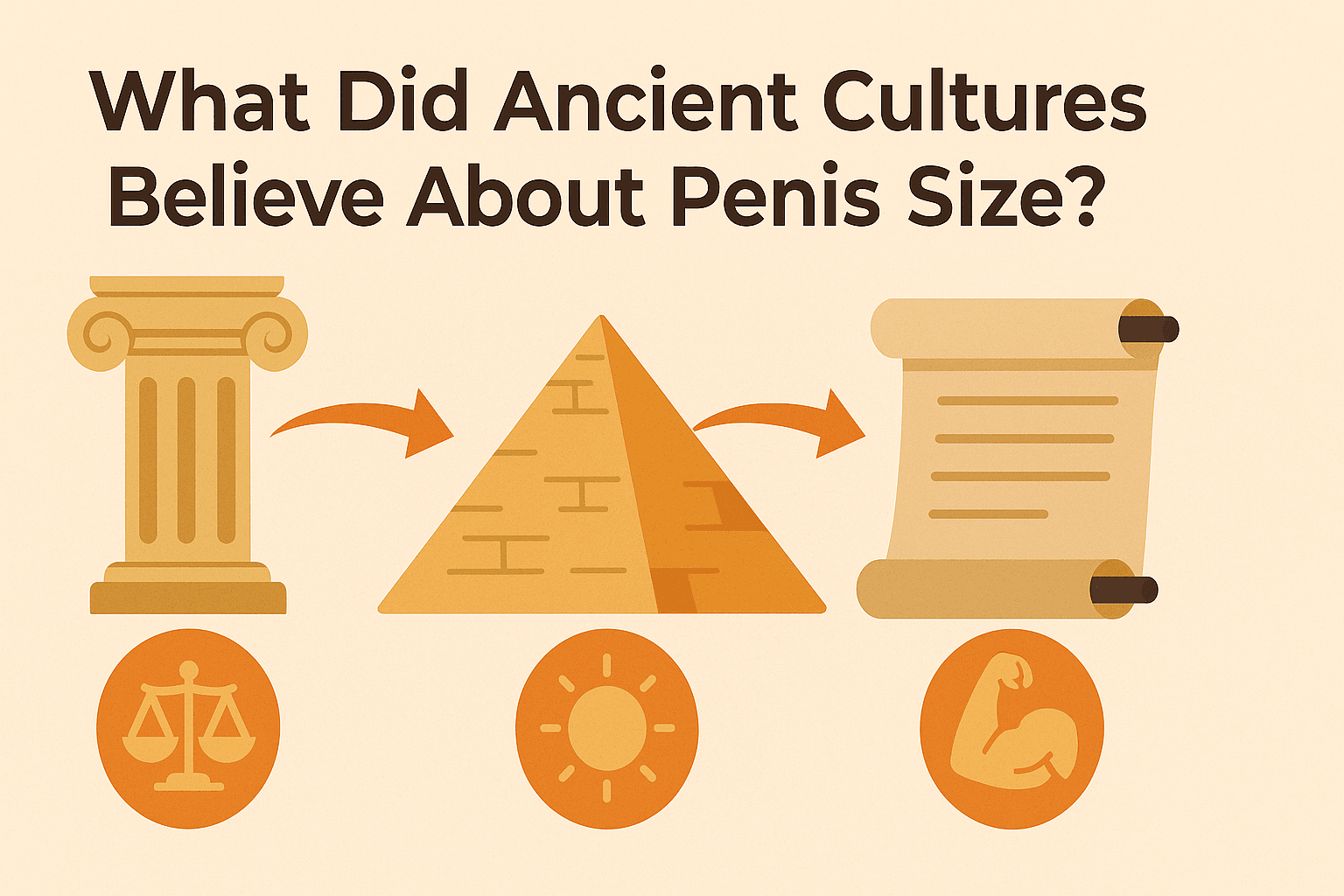
What Did Ancient Cultures Believe About Penis Size?
Ancient cultures, particularly the Greeks and Romans, held beliefs about penis size that are often the direct opposite of modern ideals, valuing a smaller, proportioned penis as a symbol of virtue while associating larger sizes with negative traits.
For a comparison based on clinician-measured data rather than stereotypes or self-reports: use the evidence-based penis size calculator.
This stark contrast between the values of powerful ancient civilizations and today’s “bigger is better” mindset challenges common assumptions about what has been considered historically desirable, especially when considering that statues have such small penises.
The modern focus on size is a relatively recent phenomenon, and understanding the historical perspective of Greek statues offers a crucial context for deconstructing contemporary societal pressures.
This guide provides a detailed analysis of ‘ancient cultural beliefs about penis size.’ We will examine the ideals of Ancient Greece and Rome, exploring how they used penis size in Greek art and philosophy to symbolize specific virtues and vices, including the notion that small penises as a sign of intellect were often overlooked.
By looking at historical evidence from art, literature, and philosophy, we can gain a factual, academic understanding of ancient cultural beliefs about penis size, including the significance of the flaccid penis in their society.
Why Did Ancient Greek Culture Believe a Smaller Penis Size Was Ideal?
Ancient Greek culture believed a smaller penis size was ideal because they associated it with rationality, intellectualism, and self-control the highest virtues for a civilized man while viewing larger sizes as primitive and lustful.
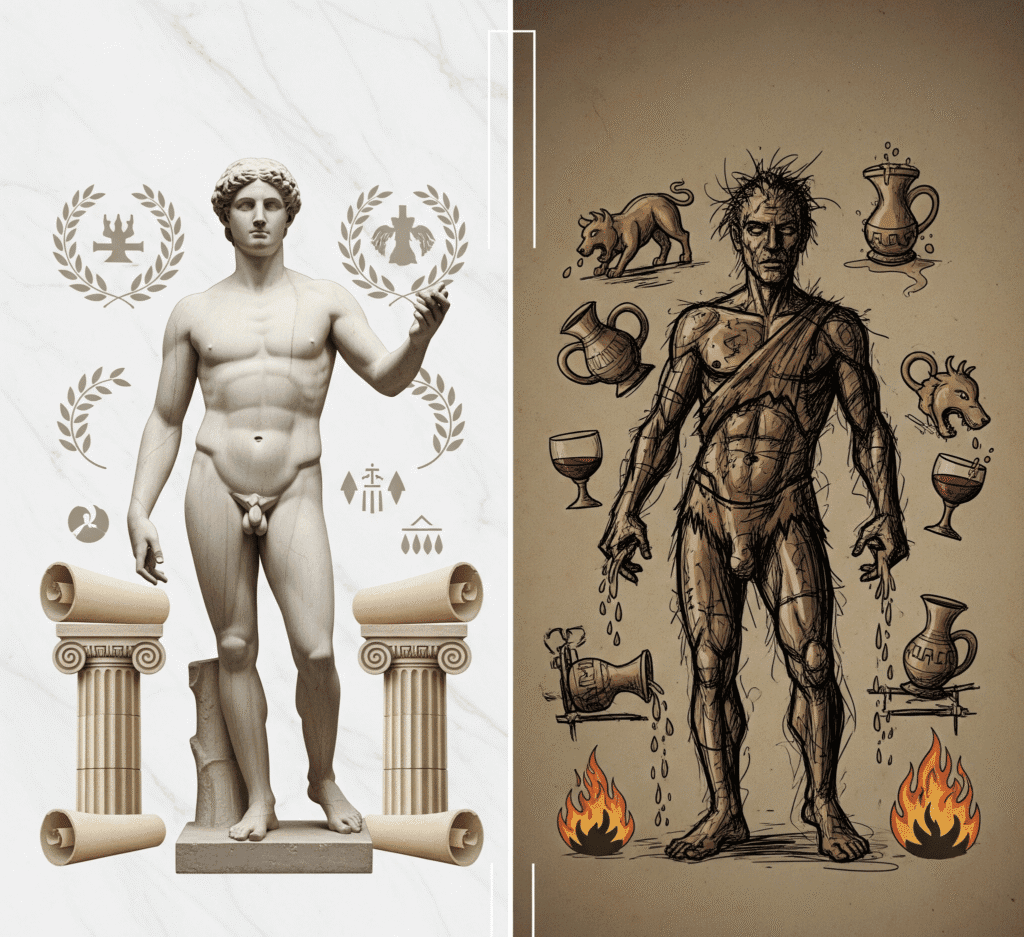
This value system permeated their philosophy, art, and social standards, creating a clear and consistent physical ideal that represented the pinnacle of male virtue.
The following sections break down the specific reasons for this belief and how it was manifested in their society, particularly in the context of how the penis was never merely a physical attribute but an index of virtue.
The Link Between a Small Penis and Rationality
The Greeks valued reason and intellect above all else, and a small, non-erect penis was seen as the physical symbol of a man who was ruled by his mind and self-control, not by his base carnal impulses.
For philosophers like Aristotle, the ideal man was one who lived a life of moderation and reason, keeping his passions and desires in check, embodying the concept of male beauty rather than succumbing to the allure of a big dick.
A large penis was seen as a marker of a man who was unable to control his lust and was therefore less civilized and less intellectually developed, contrasting sharply with the ideals presented in Greek art.
This ideal represented a man who was the master of his own desires, a core tenet of Greek virtue. You’ll also find it fascinating to see how male sex was portrayed in ancient art and sculpture.
The Depiction in Art: Gods, Heroes, and Athletes
Greek sculptures consistently depict their most revered figures including gods like Apollo, legendary heroes like Heracles, and victorious athletes with smaller, proportioned genitalia to visually emphasize their civilized, ideal, and virtuous nature. Masterpieces like the ancient Greek sculptures have small penises, which reveal deeper cultural values surrounding masculinity and aesthetics.
Kouros sculptures exemplify the Greek ideal of beauty and restraint, often featuring male bodies with small penises that symbolize their cultural values from b.c. to bce. statues have such small penises that they contrast sharply with the ideals of larger genitalia in contemporary culture. Doryphoros (Spear-Bearer), and countless depictions of gods on Mount Olympus reinforce this standard of the ideal male sex.
This artistic choice was a deliberate and conscious representation of the cultural ideal male, emphasizing that ancient Greek sculptures have small penises, which was not a reflection of anatomical reality.
By sculpting their most esteemed men with modest genitals, the Greeks visually coded them as rational, divine, and self-controlled, reinforcing the high cultural value placed on a smaller penis size in Greek art.
The Role of Nudity in Greek Society
The prevalence of public nudity in Greek society, particularly within the gymnasium culture where athletic training occurred, made the male form a constant subject of public aesthetic and philosophical evaluation, which helped solidify and propagate this specific physical ideal.
The gymnasium was a central institution for education, socialization, and athletic training, where men exercised completely nude, reflecting the Greek ideals of the male genitalia.
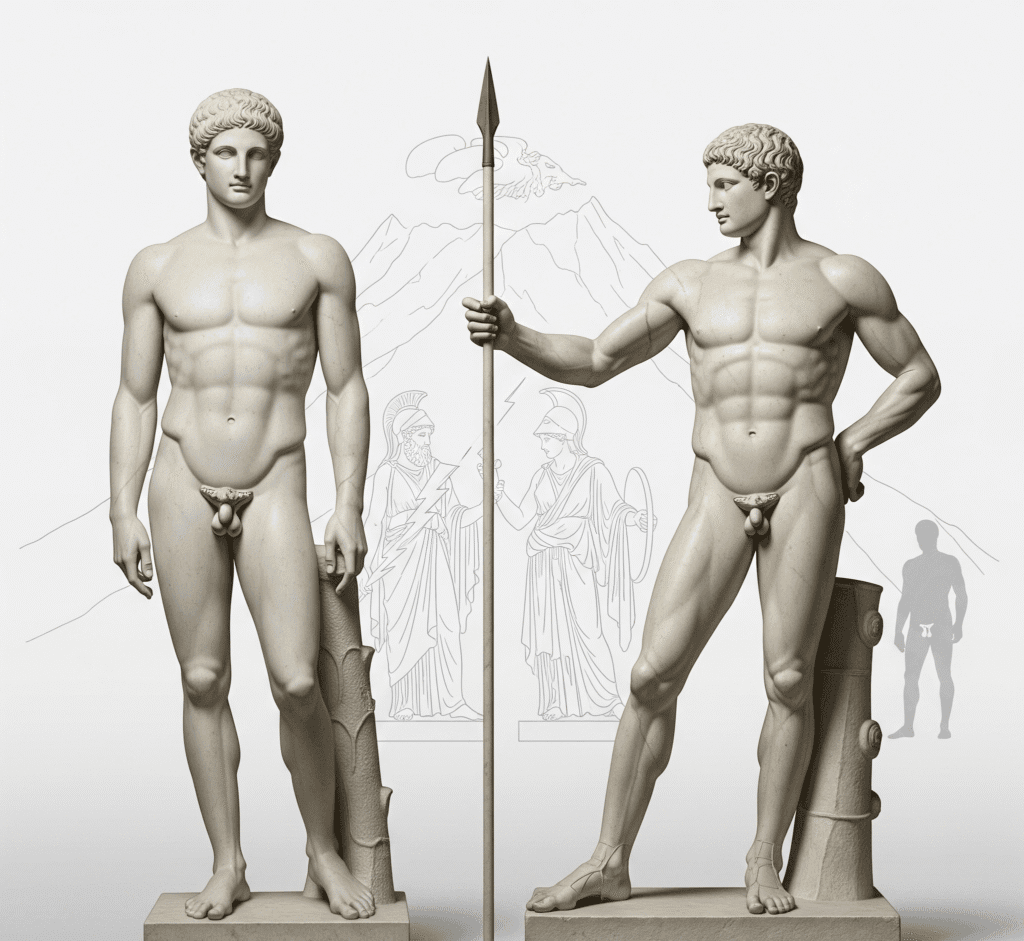
This routine public nudity meant that the male physique was not a private matter but was openly viewed, compared, and judged against established cultural standards, especially in spartan societies.
This social mechanism was key for reinforcing and normalizing the “ideal penis size,” as every man’s body was on display and subject to the prevailing aesthetic of moderation and self-control, often highlighting the contrast with small members.
How Did Ancient Cultures Use a Large Penis Size to Symbolize Negative Traits?
Ancient cultures, especially the Greeks, used a large penis size as a powerful visual symbol for negative traits such as unrestrained lust, foolishness, a lack of self-control, and a generally uncivilized, bestial nature.
Just as the small penis was a visual shorthand for all that was good and civilized, the large penis was used to instantly signify a character’s flaws and their distance from the Greek ideal.
The following sections detail this “anti-ideal” and its common representations in Greek art, mythology, and theatre, where the length of the penis often contrasted with ideals of beauty.
The Association with Lust and Lack of Control
An oversized or erect penis was explicitly associated with the negative characteristics of unrestrained lust and a profound lack of self-control, representing a man governed by his most base and animalistic desires rather than his intellect.
This is the direct philosophical opposite of the ideal of rationality and moderation celebrated in antiquity. In art and stories, this visual shorthand was used to quickly communicate a character’s flawed moral and intellectual nature, often contrasting with the idealized image of the male beauty represented by small genitals.
A large penis was a clear sign of being “less than” a civilized, ideal Greek man, marking someone as closer to an animal than to a god throughout history.
The Depiction of Satyrs and “Barbarians”
This anti-ideal is clearly demonstrated in the depiction of satyrs lecherous, half-man, half-goat figures from mythology who were almost always shown with large, erect penises to visually signify their wild, uncivilized, and lustful nature.
Satyrs were followers of Dionysus, the god of wine and revelry, and embodied everything the ideal Greek man was not: they were drunk, chaotic, and driven by carnal urges.
This same artistic convention was often extended to non-Greek “barbarians,” who were considered by the Greeks to be less civilized and intellectually inferior, reinforcing the cultural narrative around large genitalia.
Portraying them with larger genitalia was a way to visually reinforce this cultural prejudice, contrasting sharply with the reality that many Greek sculptures have small penises.
The Comedic Use in Greek Theatre
In Greek comedies, actors portraying foolish, boastful, or lustful characters would often wear exaggeratedly large, artificial phalluses (a “phallus prop”) as a comedic device to mock their lack of self-control and intelligence.
In the plays of Aristophanes, for example, these props were used for crude humor meant to generate laughter by associating a character with foolishness and base desires.
This practice demonstrates just how deeply ingrained the “large penis = foolish” concept was in the popular culture of the time; the joke was instantly recognizable and understood by the entire audience.
Contrasting Greek Ideals of Penis Size
| Attribute | The Greek Ideal (Small Penis) throughout history. | The Uncivilized Anti-Ideal (Large Penis) represents a departure from the cultural values of antiquity. |
| Symbolic Meaning in ancient Greek art often revolved around ideals of beauty and restraint, where the penis as an index of virtue played a crucial role. | Rationality, intellect, self-control, civilization—qualities that were often symbolized by the small genitals celebrated in Greek culture, especially during antiquity. | Uncontrolled lust, foolishness, barbarism. |
| Represented By Greek statues, and countless depictions of gods on Mount Olympus reinforce this standard. | Gods, heroes, athletes. | Satyrs, comedic fools, “barbarians” were often depicted with large genitals, contrasting sharply with the Greek ideal. |
| Cultural Value of the phallus in ancient Greece was often depicted through art, where the flaccid penis was seen as a symbol of moderation. | A sign of a superior, refined man, as depicted in many Greek statues, where the emphasis on small genitals symbolized restraint and intellect, laughable to those who idolized large male genitalia. | A sign of a base, animalistic nature, contrasting sharply with the ideal male depicted in Greek art, where the beautiful penis was a symbol of rationality and self-control. |
How Did Ancient Roman Beliefs About Penis Size Evolve from the Greek Ideal?
Ancient Roman beliefs about penis size evolved from the Greek ideal into a more pragmatic view; while they did not share the Greek disdain for a larger penis, their ideal was one of proportion and function, reflecting their militaristic and virility-focused culture.
The Romans absorbed many aspects of Greek culture, but they adapted them to fit their own distinct values, leading to a nuanced and different perspective on the male form.
The Roman Appreciation for Virility
The Romans, being a more militaristic and pragmatic culture than the Greeks, valued virility—a concept derived from the celebration of large genitals in their society.
“vir,” the Latin word for man, reflects the ancient Greeks’ emphasis on intellect and restraint alongside masculine power.
the Latin word for man—which shifted the focus slightly from pure intellect to include notions of masculine power and generative capability, much like the ideals of the ancient Greeks.
While the Greeks prized the contemplative man of reason, the Romans celebrated the man of action: the soldier, the patriarch, and the builder of empire.
This cultural focus on virility and power led to a different, less rigid perspective on the ideal penis size,” as a man’s generative capacity was an important aspect of his manliness, often contrasting with the reality of small members in many sculptures.
The Symbol of Fascinus: A Protective Charm
A key difference from the Greeks was the Roman use of the phallus symbol, known as the male body representation in their art, which contrasts with the Greek sculptures that have small penises. “fascinus,” a term often associated with the representation of the male body in ancient Greek art, highlights the contrasting views on size.
as a common good luck charm and a protective amulet used to ward off the evil eye, indicating it was not viewed as inherently negative or shameful.
These phallic charms were ubiquitous in Roman society, appearing on jewelry, wind chimes, and other items, celebrating the big dicks that represented virility and strength.
tintinnabulum), and even carved into buildings and roadways, where the representation of the flaccid penis served as a protective symbol, reinforcing the cultural significance of the little prick.
This common use as a protective symbol shows a fundamentally different cultural attitude toward the phallus than the Greeks had, highlighting their reverence for the beautiful penis.
For the Romans, it was a symbol of generative power and good fortune, not a sign of barbarism, as they often celebrated the beautiful penis in their art and culture.
The Ideal of Proportion, Not Exaggeration
Ultimately, the Roman ideal for penis size was one of proportion and function rather than a specific size, as they still did not hold the modern “bigger is better” view and valued an appearance that was harmonious with the rest of the body.
Roman art and sculpture, while influenced by the Greeks, often depict men with slightly more substantial but still moderate genitalia that fit the muscularity of the body.
They did not share the Greek philosophical disdain for a larger penis, but they also did not value exaggeration in their male body representations. The Roman view can be seen as a middle ground between the strict Greek ideal and the modern one.
What Are the Key Takeaways on Ancient Cultural Beliefs About Penis Size?
The key takeaways on ancient cultural beliefs about penis size are that the influential Greek ideal was small, large was seen as barbaric, the Romans valued proportion over a specific size, and the modern bigger is better mindset is a complete reversal of these classical standards.
A Summary of Ancient Beliefs on Penis Size
The Greek Ideal Was Small: In Ancient Greece, a small penis symbolized intellect and self-control, reflecting the ideals of the ancient Greeks regarding restraint.
☐ Large Was Seen as Barbaric: The Greeks used large penises to depict lustful, foolish, or non-Greek characters, while Greek playwright Aristophanes humorously critiqued these exaggerated ideals.
☐ Romans Valued Proportion: The Romans were less rigid, valuing a functional, well-proportioned size.
☐ The Modern Ideal is a Reversal: Today’s “bigger is better” mindset is the opposite of the most influential ancient ideals.
Conclusion
In conclusion, ancient cultural beliefs about penis size, particularly those from Ancient Greece, demonstrate that the ideal has not been static, having dramatically reversed from a classical standard that valued a smaller, proportioned penis as a mark of civilization to the modern, media-driven obsession with largeness.
By examining the art and philosophy of the Greeks and Romans, we see that the ideal man was defined not by his physical endowment but by his character—his rationality for the Greeks and his virility for the Romans.
This historical perspective powerfully reinforces the main message: the modern obsession with a large penis is not a timeless or universal human value but a recent cultural construct, laughable when viewed through the lens of antiquity.
Understanding this history can help dismantle the power of the modern ideal and reduce the anxiety it causes regarding a man’s penis size, as seen through the lens of ancient Greek sculptures.