
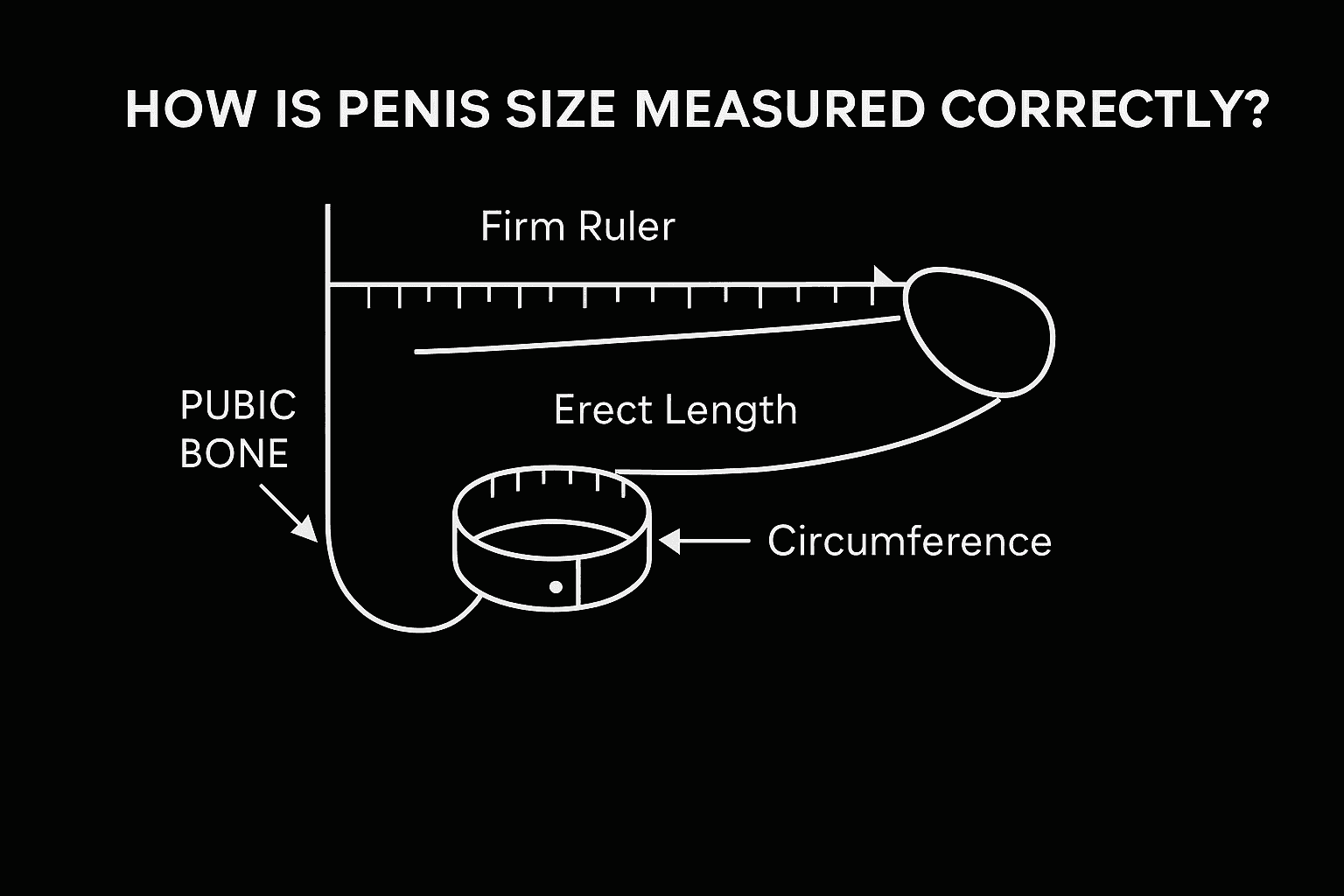
To measure penis size correctly, use a firm ruler pressed to the pubic bone to measure erect length along the top, and a flexible tape to measure the circumference at the mid-shaft.
Compare your measurement: Use the evidence-based penis size calculator to estimate a length or girth percentile from clinician-measured reference data.
Widespread misinformation and anxiety surrounding human penis size often stem from inaccurate, non-standardized self-measurements. Many men who think they have a small penis are actually within the normal penis size range but have simply measured incorrectly.
This guide provides the standardized, medically-backed procedure for a correct penis size measurement, as used in clinical settings by a urologist or other health care professionals.
We will cover the specific methods for measuring length and girth, and the common mistakes to avoid for an accurate result. Achieving a correct penis size measurement is a matter of following a precise, evidence-based protocol.
Why a Correct Penis Size Measurement is Medically Important
A correct penis size measurement is medically important because it establishes a reliable urological health baseline, helps debunk harmful myths by providing a factual perspective, and is crucial for correctly identifying specific clinical conditions.
A Correct Penis Size Measurement Establishes a Urological Health Baseline
A consistent and correct penis size measurement enables both individuals and clinicians to establish a reliable baseline for tracking urological health over time and identifying potential physiological changes.
This proactive health monitoring step grounds your understanding of your own body in objective data.
This baseline is particularly important for monitoring conditions like Peyronie’s disease, an affliction where fibrous scar tissue causes curved, painful erections. Changes in penis length or the development of curvature are key diagnostic markers a urologist would track against an established measurement.
Using a Correct Penis Size Measurement to Debunk Myths and Manage Expectations
Using the standardized method for a correct penis size measurement helps debunk prevalent myths and manage personal expectations by grounding an individual’s perspective in clinical data rather than unreliable anecdotal or pornographic depictions. Anxiety about penis size is common, but it’s often fueled by a skewed perception of what is average.
A landmark peer review published in BJU International, which analyzed data from over 15,000 men, found the average erect penis length to be 13.12 cm (5.16 inches).
Comparing one’s own accurate measurement to this clinical data provides a factual, reality-based perspective that can alleviate a great deal of mental health stress.
This factual approach is superior to comparing against the exaggerated and unrealistic depictions common in pornography or anecdotal evidence from internet forums.
Differentiating Normal Variation from Clinical Conditions with a Correct Measurement
A correct penis size measurement is essential for clinically differentiating between the wide range of normal anatomical variation and specific medical conditions, such as micropenis, which have precise diagnostic criteria.
The term micropenis is not a subjective label for a small penis; it is a clinical diagnosis made by an endocrinology or urology specialist based on a standardized measurement.
A micropenis is clinically defined as a penis with a stretched or erect length of less than 2.5 standard deviations below the mean for a person’s age. In an adult, this corresponds to a bone-pressed erect length (BPEL) of less than 9.3 cm (about 3.66 inches).
Conditions like hypogonadism, which involves insufficient testosterone production, can cause this, but it’s important to know that a true micropenis is statistically rare.
The Correct Medical Procedure for Measuring Erect Penile Length
The correct medical procedure for a correct penis size measurement of length is the Bone-Pressed Erect Length (BPEL) method, which uses a firm ruler pressed against the pubic bone to measure the penis along its top surface to the tip. This top surface is known clinically as the dorsal surface.
What Tools Are Required for a Correct Penile Length Measurement?
To achieve a correct penile length measurement, only one primary tool is required: a firm, non-flexible ruler made of a material like plastic or wood.
- Use a firm, non-flexible ruler (e.g., a standard 12-inch plastic or wooden ruler).
- Have a flat surface available for stability (optional but recommended for consistent posture).
A flexible tailor’s tape measure is unsuitable for this task. It can sag, stretch, or improperly follow the curve of the penis, introducing significant inaccuracies into the straight-line length measurement.
Step-by-Step Guide to Measuring Bone-Pressed Erect Length (BPEL)
The step-by-step guide to measuring Bone-Pressed Erect Length (BPEL) provides the scientifically accepted standard for a correct penis size measurement.
- Achieve a Full Erection. A complete erection is necessary to ensure the measurement is taken at maximum length. This consistency is vital for an accurate and repeatable result.
- Place the Ruler. Stand and place the zero end of the firm ruler against your body, directly above the base of the erect penis on its top surface.
- Press to the Pubic Bone. This is the most critical step. Gently but firmly press the ruler into the layer of fat at the base of the penis (the suprapubic fat pad) until it makes solid contact with your pubic bone. This “bone-pressed” technique is essential for a correct penis size measurement as it creates a fixed, unchangeable starting point.
- Measure to the Tip. Measure along the top (dorsal) surface of the penis from the bone to the very tip of the glans penis. Do not include extra length from the foreskin if you are uncircumcised; measure only to the end of the glans.
How to Correctly Measure Erect Penile Girth (Circumference)
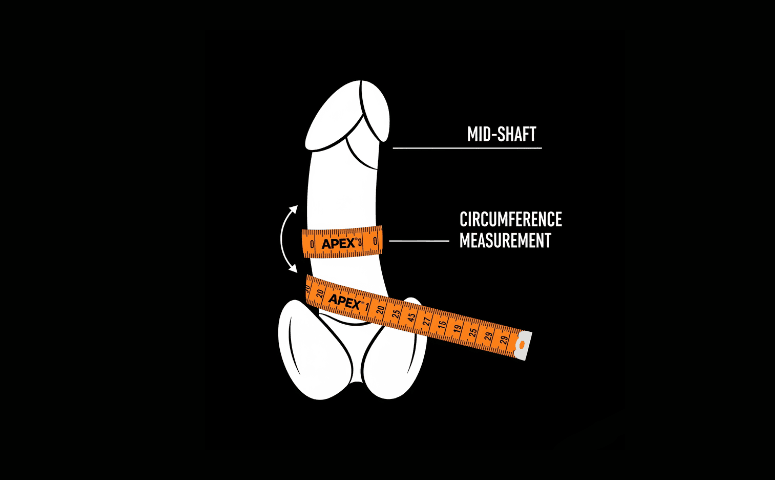
To correctly measure erect penile girth, use a flexible measuring tape wrapped around the mid-point of the shaft while fully erect, which provides the standardized circumference measurement for a correct penis size measurement.
What Tool is Required for a Correct Penile Girth Measurement?
The only tool required for a correct penile girth measurement is a flexible, non-stretchable measuring tape, such as a tailor’s tape.
- Use a flexible, non-stretchable measuring tape (like those used for sewing or tailoring).
A firm ruler is unsuitable for this measurement. It cannot wrap around the shaft and cannot accurately measure circumference, a key component of penis size.
Step-by-Step Guide to Measuring Mid-Shaft Penile Girth
This step-by-step guide details the correct procedure for measuring mid-shaft penile girth, a key component of a comprehensive and correct penis size measurement.
- Identify the Mid-Point. While you have a full erection, locate the approximate mid-point of the penile shaft, which is about halfway between the base of the penis and the tip of the glans penis.
- Wrap the Tape Measure. Gently wrap the flexible measuring tape once around the shaft at this identified mid-point. Make sure the tape is straight and not twisted.
- Read the Measurement. The tape should be snug against the skin but not so tight that it constricts or indents the tissue. The measurement where the end of the tape overlaps with the number on the tape is your erect girth.
How Common Mistakes Prevent a Correct Penis Size Measurement
Common mistakes that prevent a correct penis size measurement include measuring without pressing to the bone, using the wrong type of tool for length or girth, and measuring when not fully erect, all of which lead to unreliable results.
Mistake 1: Measuring from the Top Surface Without Pressing to the Bone
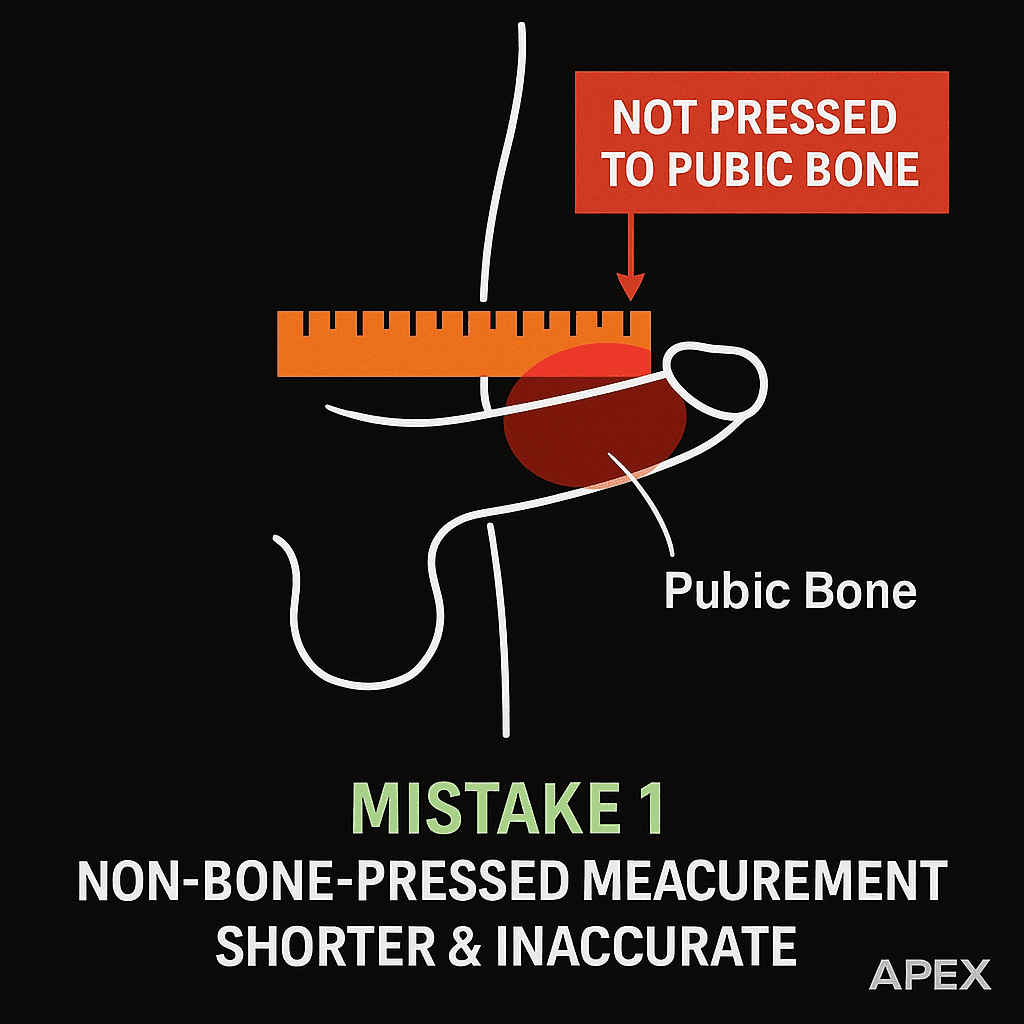
A primary mistake is measuring from the skin’s surface without pressing to the pubic bone; this “non-bone-pressed” measurement is consistently shorter and does not adhere to the medical standard for a correct penis size measurement.
This method is inaccurate because it fails to account for the variable thickness of the pre-pubic fat pad.
The American Urological Association (AUA) and global research bodies recognize BPEL as the clinical standard precisely because it removes this variable.
Mistake 2: Using the Wrong Measuring Tool
Using the wrong measuring tool, such as a flexible tailor’s tape for length or a rigid ruler for girth, is a common mistake that will invariably lead to an inaccurate penis size measurement.
A cloth or plastic tape measure can stretch or curve, artificially shortening or lengthening the reading for a straight-line measurement.
A firm ruler cannot accurately wrap around the penile shaft to measure its circumference. Always use a firm ruler for length and a flexible tape for girth.
Mistake 3: Measuring a Flaccid or Partially Erect Penis
Attempting to measure a flaccid or partially erect penis is a frequent error; a correct penis size measurement for both length and girth requires a full, complete erection.
Flaccid size is highly variable and can change significantly due to factors like room temperature, anxiety, or time of day.
The medical and scientific standards for penis measurement are based on the erect state because it represents the human penis at its maximum, most consistent size.
Mistake 4: Measuring from the Side or Bottom of the Penis
Another common mistake is measuring from the side or bottom of the penis; the medical standard for a correct penis size measurement of length is exclusively along the top (dorsal) surface from the pubic bone to the tip.
This is the standardized anatomical reference point used in all clinical research. Measuring from other angles can produce inconsistent results due to natural curvature and anatomical differences, which is why a single standard is essential for accuracy.
Final Checklist for a Correct and Repeatable Penis Size Measurement
This final checklist provides a scannable summary of all critical steps, ensuring you can perform a correct, repeatable, and accurate penis size measurement for both length and girth according to medical standards.
- ☐ Achieve Full Erection: A correct penis size measurement requires a full, consistent state of tumescence.
- ☐ Use a Firm Ruler for Length: A non-flexible ruler is required for an accurate BPEL measurement.
- ☐ Measure on Top Surface Only: The dorsal side is the medical standard for all length measurements.
- ☐ Press Ruler Firmly to Pubic Bone: This negates the fat pad and is the most critical step for accuracy.
- ☐ Use a Flexible Tape for Girth: A non-stretchable tailor’s tape is required for an accurate circumference measurement.
- ☐ Measure Girth at Mid-Shaft: This provides a consistent and repeatable point of reference.
Frequently Asked Questions (FAQ) About Correct Penis Size Measurement
To further clarify the process, this section addresses frequently asked questions regarding the nuances of achieving a correct penis size measurement.
Does flaccid size have any relation to erect size?
There is no reliable correlation. Some individuals (“growers”) have a significantly larger erect penis compared to their flaccid state, while others (“showers”) have a flaccid size that is closer to their erect size. Because of this high variability, flaccid measurement is not a clinically useful indicator of erect penis size.
What is the most important factor for an accurate measurement?
For length, the single most critical factor is correctly performing the bone-pressed technique. For both length and girth, using the correct tool—a firm ruler for length and a flexible tape for girth—is equally crucial.
Should I measure more than once?
Yes. For the most reliable personal data, it’s wise to take several measurements on different occasions and calculate the average. This helps account for minor variations in erection quality and ensures your final number is as accurate as possible.
Glossary of Clinical Terms
| Term | Definition |
|---|---|
| Bone-Pressed Erect Length (BPEL) | The medical standard for measuring erect penis length, taken from the top side by pressing a firm ruler against the pubic bone to the tip. |
| Dorsal Surface | The top surface of the penis when it is pointing straight out from the body. |
| Glans Penis | The head or tip of the penis. |
| Pubic Bone (Pubis) | The bone at the front of the pelvis, which serves as the fixed starting point for a BPEL measurement. |
| Suprapubic Fat Pad | The layer of adipose tissue located over the pubic bone at the base of the penis. |
Conclusion
In conclusion, achieving a correct penis size measurement is a straightforward process when the medically accepted techniques—the bone-pressed method for length and the mid-shaft measurement for girth—are used with the proper tools. Accuracy and precision rely on adhering to these two key principles.
The purpose of obtaining a correct penis size measurement is for personal knowledge and health awareness, not for comparison against unreliable, non-standardized sources.
Understanding your own body correctly and factually is a vital step in proactive personal health management.

One Response